
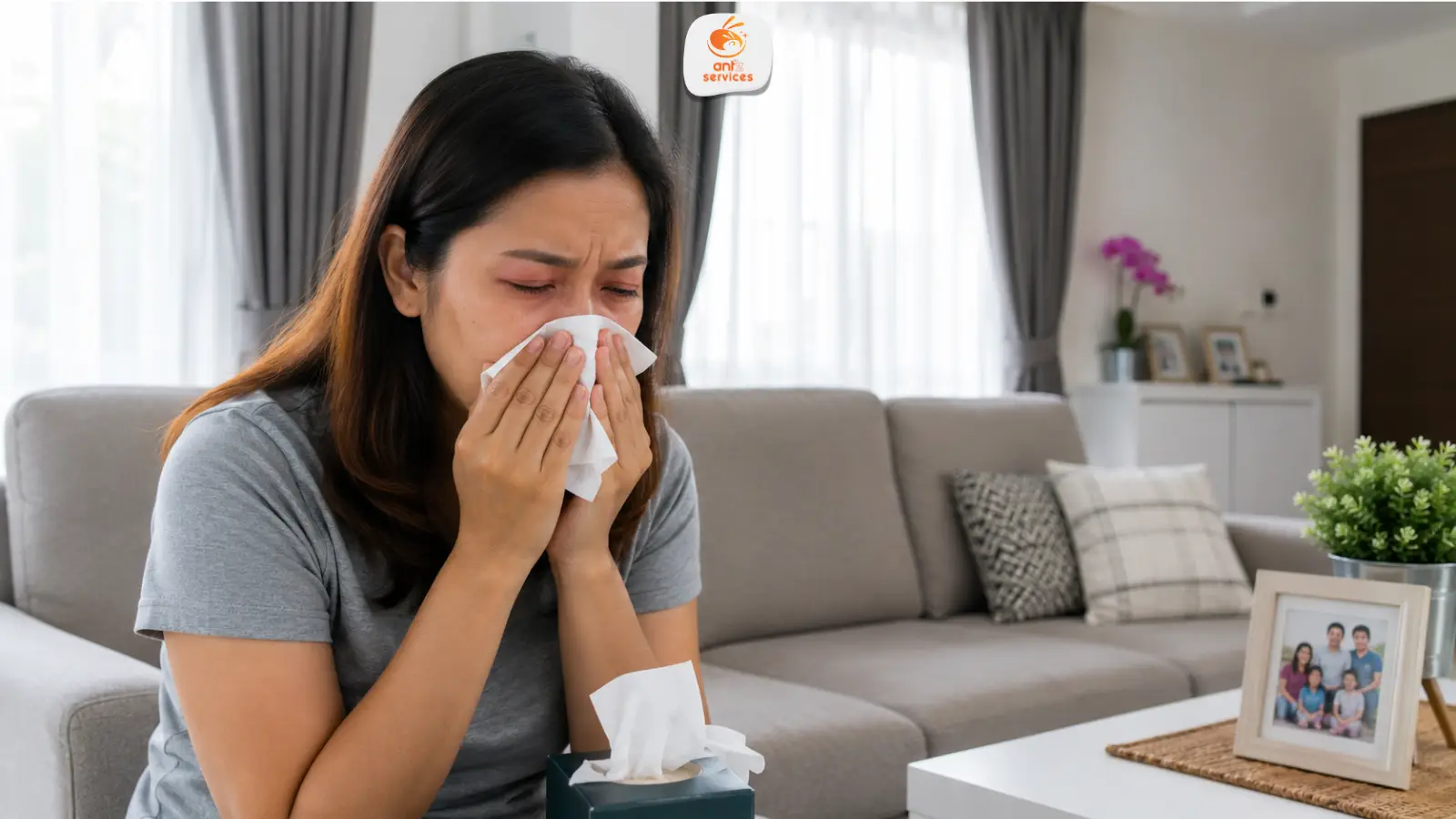
Some households deal with sneezing, a blocked nose, itchy eyes, or worsening asthma at home all year round, rather than in a seasonal pattern. In Malaysia, indoor allergens are very often the cause. Sensitisation to house dust mite allergens is widespread here, among the highest rates in Asia. Cleaning for allergy Malaysia needs a different approach from the generic advice written for temperate climates. Our year-round humidity creates continuous allergen breeding conditions, and a seasonal cleaning routine cannot keep pace with that. So this guide ranks the cleaning tasks that matter most, gives you a practical frequency for each, and explains when professional cleaning is needed to reset an allergen load that home routines cannot fully clear.
A note before the detail: cleaning reduces allergen exposure, but it does not replace medical care. If you or a family member has asthma or persistent allergy symptoms, work with a doctor on diagnosis and treatment alongside the cleaning routine below.
Key Takeaways
- House dust mites are the primary indoor allergen in Malaysia, and a large share of people with allergic rhinitis or asthma here are sensitised to them.
- The mattress, sofa, and carpet hold the highest allergen concentrations in any Malaysian home, so cleaning these has the greatest effect on symptoms.
- Most global guides recommend keeping humidity below 50 percent. That is not realistic in Malaysia, so the practical approach is targeted allergen removal instead.
- Cockroach allergen is a significant but under-recognised trigger here, which makes kitchen and floor cleaning frequency matter for that allergen specifically.
- Professional extraction cleaning every 3 to 6 months resets allergen levels in soft furnishings for most allergy sufferers.
Why Malaysia’s Allergy Problem Is Different
Most cleaning-for-allergy guides are written for countries where allergen exposure peaks in spring and summer, then falls in cooler, drier months. In those climates, sufferers get natural relief once temperatures drop and humidity falls below 50 percent.
Malaysia offers no such break. Year-round temperatures of 26°C to 32°C and humidity of 70 to 90 percent give dust mites continuous ideal breeding conditions. Studies of tropical housing consistently find higher dust mite densities than in temperate countries, and our climate is the reason.
So for cleaning for allergy Malaysia to work, the routine has to be continuous rather than seasonal. It also has to include regular extraction cleaning that pulls allergens out from inside soft furnishings, not just surface cleaning.
The Four Main Indoor Allergens
1. House dust mite allergens, the primary trigger
Dust mites produce allergens in their faecal particles and shed body fragments. Here they breed continuously in every home, inside mattresses, pillows, sofas, carpets, and curtains. The allergen particles are fine enough to stay airborne for a while after being disturbed. That makes bed-making, sitting down on the sofa, and vacuuming all potential exposure moments for sensitised people.
For a detailed guide to dust mites, see our dust mites vs bed bugs Malaysia guide.
2. Mould spores, a secondary trigger
Our humidity makes mould a persistent presence in bathrooms, window frames, curtain hems, and mattress undersides. Spores released into indoor air trigger allergic rhinitis and can worsen asthma. This is most pronounced during the Southwest Monsoon, from May to September, when indoor humidity peaks.
For mattress mould specifically, see our mattress mould Malaysia guide.
3. Cockroach allergen, the under-recognised trigger
Cockroach droppings, shed body parts, and saliva contain allergens that are a major trigger for asthma and rhinitis. This matters especially in Malaysia, where the climate supports year-round cockroach activity. In urban tropical homes, cockroach allergen is generally considered one of the leading indoor allergens after dust mites.
It concentrates on kitchen floors, beneath appliances, inside cabinets, and along wall junctions. Unlike dust mite allergen, it is not removed by HEPA vacuuming alone. Instead it needs wet cleaning with appropriate products.
4. Pet dander, a secondary trigger in pet-owning homes
In households with indoor pets, dander adds a further allergen burden on top of dust mites. It settles on soft furnishings, particularly the sofa and carpet, and combines with dust mite allergen to raise the total load in those homes.
Ranked by Impact
Not all cleaning tasks reduce allergen exposure equally. This ranking helps you prioritise.
Level 1, highest: mattress and pillow
The mattress is the single highest-concentration dust mite habitat in any Malaysian home. An adult spends 6 to 8 hours a night with their face close to mattress fabric. That makes it the most sustained allergen contact anyone has with any surface in the house.
Home routine: Vacuum the surface weekly with an upholstery attachment, on sheet-change day. Use a breathable waterproof protector and wash it monthly in hot water. Wash pillowcases twice weekly.
Professional cleaning: Every 3 to 4 months for allergy households. Hot water extraction removes dust mites, allergen particles, and mould spores from within the fabric, well beyond any vacuum’s reach. See our mattress cleaning price guide for pricing.
Level 2, high: sofa and upholstered furniture
The sofa is where people spend the most waking hours in direct fabric contact, several hours daily in most Malaysian homes. That extended contact makes it the second biggest exposure source after the mattress.
Home routine: Vacuum all surfaces weekly with an upholstery attachment. Use washable covers where practical and wash them monthly.
Professional cleaning: Every 3 to 6 months for allergy households. Extraction removes dust mites and allergens from the full depth of the fabric, not just the surface layer.
Level 3, high: carpet and rugs
Carpet fibres trap and hold dust mite allergen, pet dander, cockroach allergen, and mould spores. Foot traffic then makes those allergens airborne. As a result, carpeted rooms are higher-allergen environments than hard-floor rooms cleaned at the same frequency.
Home routine: Vacuum twice weekly with a HEPA-filtered vacuum. Avoid dry sweeping, which redistributes allergens rather than removing them.
Professional cleaning: Every 3 months for high-traffic carpeted areas in allergy households, and every 6 months for lower-traffic areas.
Level 4, medium: curtains
Curtains act as passive collectors. Dust mite particles, mould spores, and cooking vapours all settle on the fabric continuously. Curtains near sliding doors also pick up indoor humidity, which makes them a mould risk as well as a dust source.
Home routine: Vacuum the full length, including the hem, every 2 to 3 months with the upholstery attachment.
Professional cleaning: Every 6 months for allergy households. On-site steam cleaning removes allergens and kills mould spores without taking the curtains down.
Level 5, medium: hard floors and surfaces
Hard tile and vinyl floors hold far fewer allergens than carpet, because particles do not embed and mopping removes them easily. However, technique matters.
Home routine: Mop twice weekly with a damp mop rather than a dry broom. Dry sweeping pushes fine allergen particles into the air, while damp mopping traps them. Prioritise the area around and beneath the bed, since disturbed mattress allergens settle there.
Kitchen floors: For cockroach allergen, damp mop twice weekly with a suitable antibacterial product. Pay particular attention beneath the refrigerator and stove, and along the base of cabinets.
Level 6, lower: shelves and hard surfaces
Shelves, furniture tops, and window sills collect allergen particles, but at much lower concentrations than fabric. Wipe them with a damp cloth rather than a dry duster, because dry dusting redistributes particles instead of removing them.
Frequency Schedule
| Item | Home Routine | Professional Cleaning |
|---|---|---|
| Mattress (vacuum) | Weekly, on sheet change day | Every 3 to 4 months |
| Pillows and pillowcases | Pillowcase twice weekly, pillow monthly | Every 3 to 4 months (extraction) |
| Sofa | Weekly vacuum | Every 3 to 6 months |
| Carpet | Twice weekly HEPA vacuum | Every 3 months (high traffic) |
| Curtains | Vacuum every 2 to 3 months | Every 6 months |
| Hard floors | Damp mop twice weekly | Not required |
| Kitchen floors | Twice weekly damp mop | Professional home clean monthly |
| Bedsheets | Weekly hot wash at 60°C or above | Not applicable |
| Mattress protector | Monthly hot wash | Not applicable |
The Practical Reality of Humidity Here
Most guides repeat the global advice to keep indoor humidity below 50 percent, since dust mites cannot survive below that level. The science is sound. However, holding 50 percent year-round in a Malaysian home is impractical without industrial dehumidification running continuously.
The realistic target is to reduce humidity exposure during sleep, which is the most critical window. Running the bedroom AC overnight brings humidity to roughly 55 to 65 percent while it operates, against 85 to 90 percent in an unventilated room. That does not eliminate dust mites. It does slow their population growth between professional cleaning sessions.
When the AC is off, ceiling fans, opening windows in dry weather, and a small bedroom dehumidifier all add incremental reduction that supports the cleaning routine.
When Professional Cleaning Resets the Load
Home routines maintain allergen levels well after a reset. What they cannot do is achieve that reset, because vacuuming and wiping only reach the top layer. The deeper allergen inside mattress foam, sofa cushioning, and carpet pile stays out of reach.
So for allergy sufferers here, the most effective approach pairs professional extraction cleaning every 3 to 4 months for mattress and sofa with a consistent home routine in between. That combination:
- Removes the deep allergen layer through extraction
- Holds levels down through weekly vacuuming and monthly protector washing
- Resets again before allergens rebuild to where symptoms return
At Antz Services, we provide mattress cleaning from RM80, sofa cleaning from RM80 for a 1-seater, and carpet cleaning from RM1 per sqft. All of it is on-site across more than 62 areas in KL and Selangor, with no transportation charges.
Frequently Asked Questions
What cleaning reduces dust mite allergy symptoms most in Malaysia?
The highest-impact cleaning for allergy Malaysia tasks, in order, are professional mattress extraction cleaning, professional sofa cleaning, twice-weekly HEPA vacuuming of carpets, weekly mattress surface vacuuming, and a weekly hot wash of bedsheets. Professional mattress and sofa cleaning every 3 to 4 months gives the largest and most sustained reduction in allergen load.
How often should allergy sufferers clean their home here?
For daily management, damp mop hard floors and wipe surfaces twice weekly. For soft furnishings, vacuum the mattress weekly and the sofa and carpet twice weekly. For professional cleaning, book mattress and sofa every 3 to 4 months, carpet every 3 months in high-traffic areas, and curtains every 6 months. Because dust mites breed here year-round, run this schedule continuously with no seasonal break.
Does professional mattress cleaning help with allergies?
It helps by removing the allergen source. Hot water extraction takes dust mite allergen particles, mould spores, and dead skin cells out of the mattress fabric, to a depth no home vacuum reaches. Many people with dust mite sensitivity report easier mornings afterwards, though individual results vary. In Malaysian conditions, allergen levels typically rebuild over 3 to 4 months, which is why the cycle repeats.
Is cockroach allergen a problem in Malaysian homes?
Yes, more than most homeowners realise. Allergen from droppings, shed skins, and body fragments is among the leading indoor triggers here after dust mites. It concentrates in kitchens, beneath appliances, and along wall junctions. So regular damp mopping of kitchen floors, sealing food in containers, and general kitchen hygiene all reduce exposure alongside dust mite management.
Which professional services help most with allergy?
Mattress extraction cleaning is the highest-impact single service. Combined with sofa cleaning, the two cover the soft furnishings where you spend the most time in direct fabric contact. In carpeted homes, professional carpet cleaning every 3 months adds a further reduction. Book a mattress clean or book a home clean with Antz Services across more than 62 KL and Selangor locations.
Conclusion
Cleaning for allergy Malaysia calls for a continuous routine rather than a seasonal one, because dust mites here breed every month without interruption. The highest-impact tasks are professional mattress and sofa extraction cleaning every 3 to 4 months, supported by weekly home vacuuming of both. Carpet and curtain cleaning every 3 to 6 months reduces the total indoor allergen load further.
Alongside all of this, keep working with your doctor on any diagnosed allergy or asthma. Cleaning lowers exposure, but it is one part of managing the condition rather than a treatment on its own.
Antz Services provides all the major allergen-reduction services, covering mattress, sofa, carpet, and curtain cleaning, across more than 62 areas in KL and Selangor with no transportation charges.
Need Help With Home Cleaning?
Antz Services helps homeowners and tenants across KL & Selangor with reliable, professional home cleaning for regular upkeep, move-in, move-out, and deep cleaning needs.


