Waking up itchy and not knowing whether you are dealing with dust mites vs bed bugs is one of the most common bedroom problems in Malaysian homes. Both live in your mattress. Both affect your sleep. However, they are completely different creatures, and they need completely different solutions. Get the diagnosis wrong and you spend time and money on the wrong treatment, while the problem continues. So this guide gives you a practical way to tell them apart. It also explains which is more likely in a Malaysian home, and what to do about each one.
Key Takeaways
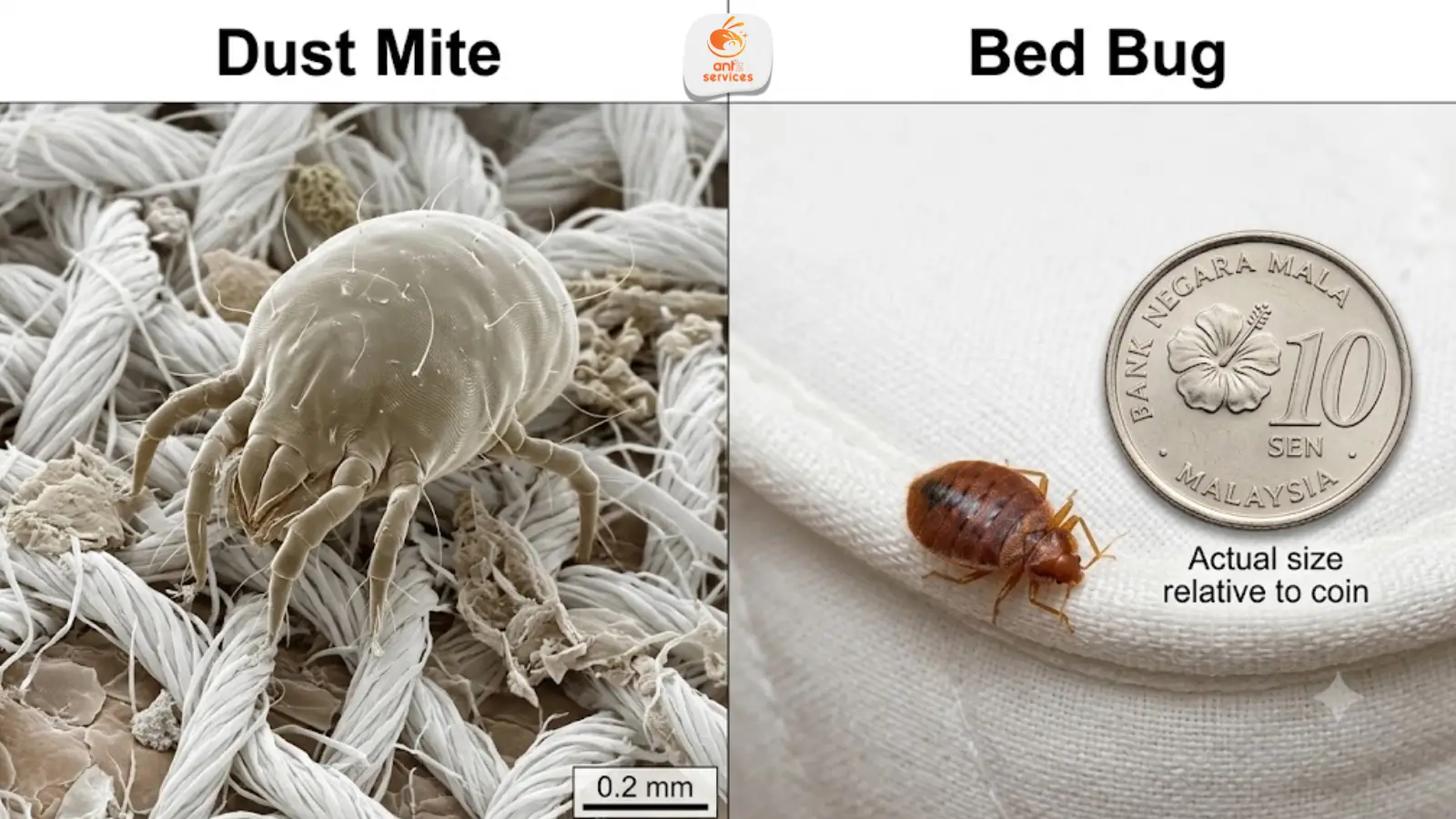
- Dust mites are microscopic, at 0.2 to 0.3 mm, and invisible to the naked eye. Bed bugs are visible insects at 5 to 7 mm, roughly the size of an apple seed.
- Dust mites do not bite. The symptoms they cause, such as sneezing, runny nose, itchy eyes, and skin rash, come from allergens in their waste and body fragments.
- Bed bugs do bite. They feed on blood and leave visible red welts, usually in lines or clusters on exposed skin.
- Dust mites are far more common than bed bugs in Malaysian homes.
- Dust mites are treated with professional extraction cleaning. Bed bugs need specialist pest control, because cleaning alone will not eliminate an infestation.
The Single Most Important Difference
Before the details, one difference matters more than the rest.
Dust mites do not bite you. They are too small, they have no mouthparts designed to break skin, and they do not feed on blood. So if you have bite marks, they did not come from dust mites.
Bed bugs do bite you. They are parasites that feed on blood, and they leave physical evidence behind, including marks on your skin and blood stains on your sheets.
That single distinction clears up most of the confusion. If you have bite marks, suspect bed bugs, or mosquitoes, which are more common than either. If you have allergy symptoms such as sneezing, a blocked nose, or itchy eyes, with no visible bites, suspect dust mites.
Dust Mites vs Bed Bugs: Side-by-Side Comparison
| Feature | Dust Mites | Bed Bugs |
|---|---|---|
| Size | 0.2 to 0.3 mm, invisible to the eye | 5 to 7 mm, visible, like an apple seed |
| Appearance | 8 legs, spider-like, translucent | 6 legs, oval, flat, reddish-brown |
| Do they bite? | No | Yes, they feed on blood |
| Symptoms caused | Allergic reactions: sneezing, itchy eyes, blocked nose, skin rash | Bite marks: red welts on exposed skin, often in lines or clusters |
| Visible signs in the bedroom | None, they leave no physical trace | Blood stains on sheets, dark faecal spots on mattress seams, shed skins |
| Where they live | Mattresses, pillows, sofas, carpets, curtains, anywhere with fabric | Mattress seams, bed frame crevices, furniture joints, electrical outlets |
| How common in Malaysia | Extremely common | Less common, usually linked to recent travel or secondhand furniture |
| Treatment | Professional extraction cleaning of mattress, sofa, carpet | Specialist pest control, either chemical or heat treatment |
Which Is More Likely in Your Malaysian Home?
It helps to know which one is statistically more likely here.
Dust mites are far more common than bed bugs in Malaysia. Research has found that a large majority of Malaysians are sensitised to house dust mite allergens, among the highest rates in Asia. The reason is climate. Malaysia’s year-round humidity of 70 to 90 percent, with temperatures of 26°C to 32°C, creates continuous ideal breeding conditions. In practice, every occupied Malaysian home has dust mites. The only real question is whether the population is large enough to trigger symptoms.
Bed bugs are different. They are not endemic to Malaysian homes in the same way. Instead, most infestations trace back to a specific introduction, such as staying in an affected hotel, buying secondhand furniture, or hosting guests who brought them in. So if you have not travelled recently, bought secondhand bedding or furniture, or had guests stay, bed bugs are considerably less likely than dust mites.
How to Tell Which One You Have
Work through these three steps.
Step 1: Check for physical signs
Take a torchlight and inspect your mattress seams, bed frame joints, and the area behind the headboard. Look for:
- Dark brown or black ink-like spots along mattress piping or seams, which is bed bug faecal matter
- Rusty red smear marks on sheets or pillowcases, from crushed bugs
- Shed skin casings, which are translucent, hollow insect shells in mattress crevices
- Live bugs, reddish-brown, flat, oval, and about 5 to 7 mm
If you find any of these, you likely have bed bugs. If you find none, dust mites are more likely.
Step 2: Examine your symptoms
Symptoms that point to dust mites:
- Morning sneezing that clears up after you leave the bedroom
- A blocked or runny nose, or post-nasal drip, that is worse at home than outside
- Itchy, watery eyes, worse in the bedroom or after being in bed
- Skin rash or eczema that worsens at night, or after contact with the mattress or sofa
- Year-round symptoms with no seasonal pattern, since Malaysia has no seasonal dust mite slowdown
- No visible bite marks
Symptoms that point to bed bugs:
- Visible red welts on exposed skin, such as arms, legs, neck, and face
- Marks appearing in lines, clusters, or the classic zigzag pattern
- Marks that appear after sleeping, and were not there when you went to bed
- Burning or itching that intensifies over a day or two
- Symptoms that started after recent travel or new secondhand furniture
Step 3: Check when symptoms occur
Dust mite exposure peaks when you are in bed or on the sofa, because allergen particles go airborne when fabric is disturbed. So symptoms are often worst in the morning, then improve after a few hours away from home.
Bed bug bites work differently. You do not feel them happen, since the bug injects an anaesthetic as it feeds. Marks typically appear several hours later, which makes the timing harder to trace.
If skin symptoms persist, spread, or look infected, see a doctor or pharmacist rather than relying on self-diagnosis.
Why Malaysia’s Climate Makes Dust Mites Worse
Malaysia’s humidity is the main reason local dust mite populations run so high. Dust mites thrive above 70 percent humidity, which Malaysian homes sit at continuously, all twelve months. In temperate countries, winter drops indoor humidity below 50 percent, which slows reproduction and causes populations to decline seasonally. Here there is no such brake.
Soft furnishings add to it. Carpeted prayer rooms, upholstered sofas, and a general soft-furnishing culture all create abundant habitat. As a result, a mattress left unclean for 12 months in Malaysia will usually hold far more dust mite allergen than the same mattress in a European home, simply because breeding never pauses.
What to Do If You Have Dust Mites
You cannot eliminate dust mites permanently, because they are present in every occupied home. The realistic goal is to cut the population and allergen load below the level that triggers symptoms.
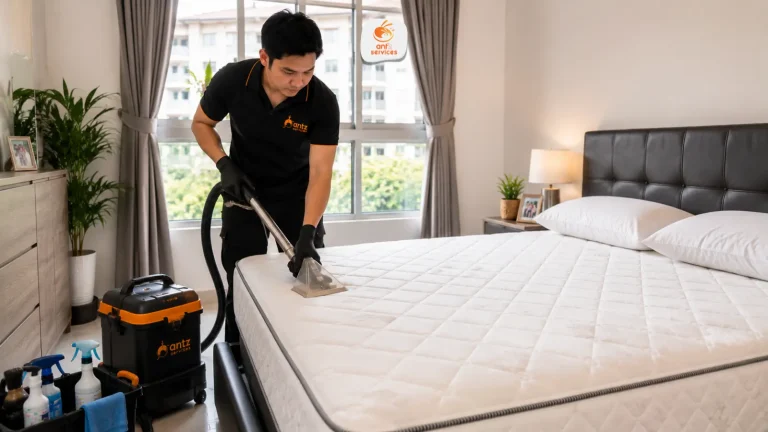
Step 1: Professional extraction cleaning of your mattress. The heaviest concentration in any home is usually inside the mattress. Hot water extraction pulls dust mites, waste particles, and shed fragments out from within the fabric, which reduces allergen load considerably. Vacuuming alone just moves allergens around the surface without extracting them.
At Antz Services, mattress cleaning starts from RM80 per unit. See our mattress cleaning price guide for full pricing.
Step 2: Clean your sofa and carpets. These are the second and third largest habitats in a Malaysian home. Cleaning the mattress while leaving them untreated gives you incomplete allergen reduction. So for best results, do all three in the same period, ideally within the same week.
Step 3: Use a waterproof mattress protector. After cleaning, a breathable waterproof protector puts a physical barrier between you and the fabric. This blocks the skin cell deposits that feed dust mites and slows the population recovering between cleans.
Step 4: Maintain between sessions. Weekly vacuuming of mattress, sofa, and carpet surfaces, monthly baking soda on the mattress, and a weekly hot wash of bedsheets all slow population growth. See our mattress cleaning tips Malaysia guide for the full routine.
Step 5: Book professional cleaning every 6 months. For most Malaysian households, this keeps allergen levels below the symptom threshold. Families with allergy sufferers do better with every 3 to 4 months.
What to Do If You Have Bed Bugs
Bed bugs need a different response, and this distinction matters.
Professional cleaning does not eliminate bed bugs. Hot water extraction removes allergens and organic matter from fabric surfaces. However, it does not reach where bed bugs actually live, which is deep in mattress seams, bed frame crevices, furniture joints, and behind skirting boards. A mattress clean improves surface hygiene, but it will not solve an infestation.
Bed bugs need specialist pest control. In Malaysia, licensed operators use chemical treatment with residual insecticides applied to all hiding places, heat treatment that raises room temperature above 50°C to kill bugs at every life stage, or a combination. This is a separate specialist service from cleaning.
So if Step 1 above turned up physical evidence, contact a licensed pest control operator rather than a cleaning service. Once treatment is complete, a professional mattress clean is a sensible follow-up to remove debris and residue.
Frequently Asked Questions
Do dust mites bite?
No. Part of the dust mites vs bed bugs question is exactly this: dust mites do not bite at all. They feed on shed human skin cells rather than blood, and they have no mouthparts capable of breaking skin. The skin symptoms they cause, such as rash, itching, and redness, come from allergens in their waste and body fragments.
What do dust mite reactions look like compared to bed bug bites?
Dust mites leave no bite marks. Skin reactions from exposure tend to look like eczema, hives, or a diffuse rash, usually on areas that contact mattress fabric such as the back, neck, and arms. Bed bug bites look like red, raised welts, often in a line or a cluster of 3 to 5 marks on exposed skin.
Are dust mites and bed bugs the same thing?
No. Dust mites are microscopic arachnids, related to spiders, that feed on shed skin cells and cause allergic reactions through their waste. Bed bugs are visible insects that bite and feed on blood. They are entirely different species, with different appearances, behaviours, symptoms, and treatments.
How do I know which one I have?
Check your mattress seams and bed frame with a torchlight. If you find blood stains, dark faecal spots, shed skins, or live bugs, you likely have bed bugs. If you find no physical evidence but do have allergy symptoms, especially in the morning, dust mites are more likely. In a Malaysian home with no recent travel or secondhand furniture, dust mites are by far the more probable cause.
Can professional mattress cleaning remove dust mites?
Yes. Hot water extraction removes dust mites, their waste particles, and allergens from within the mattress fabric, which reduces allergen load considerably. Antz Services provides this from RM80 per mattress across more than 62 locations in KL and Selangor. See our mattress cleaning Selangor guide for Selangor coverage.
Can professional mattress cleaning remove bed bugs?
Not on its own. Cleaning improves surface hygiene, but it does not reach bed bugs in seams, crevices, and furniture joints. You need a licensed pest control operator for eradication. Afterwards, a professional mattress clean is a good follow-up to clear dead bugs and treatment residue.
Conclusion
The dust mites vs bed bugs question comes down to one check: look for physical evidence in your mattress seams and bedding. Blood stains, dark spots, or visible insects point to bed bugs, which need pest control. No physical evidence, combined with allergy symptoms, points to dust mites, which need professional extraction cleaning of your mattress, sofa, and carpet.
In Malaysian homes, dust mites are the far more likely cause. The year-round humidity creates continuous breeding conditions, and sensitisation rates here are among the highest in the region.
At Antz Services, professional mattress cleaning starts from RM80 and covers more than 62 locations across KL and Selangor. For full pricing, see our mattress cleaning price guide.
Need Help With Mattress Cleaning?
Antz Services helps households across KL & Selangor with professional mattress cleaning to remove dust, stains, odours, and allergens for a fresher sleep environment.