
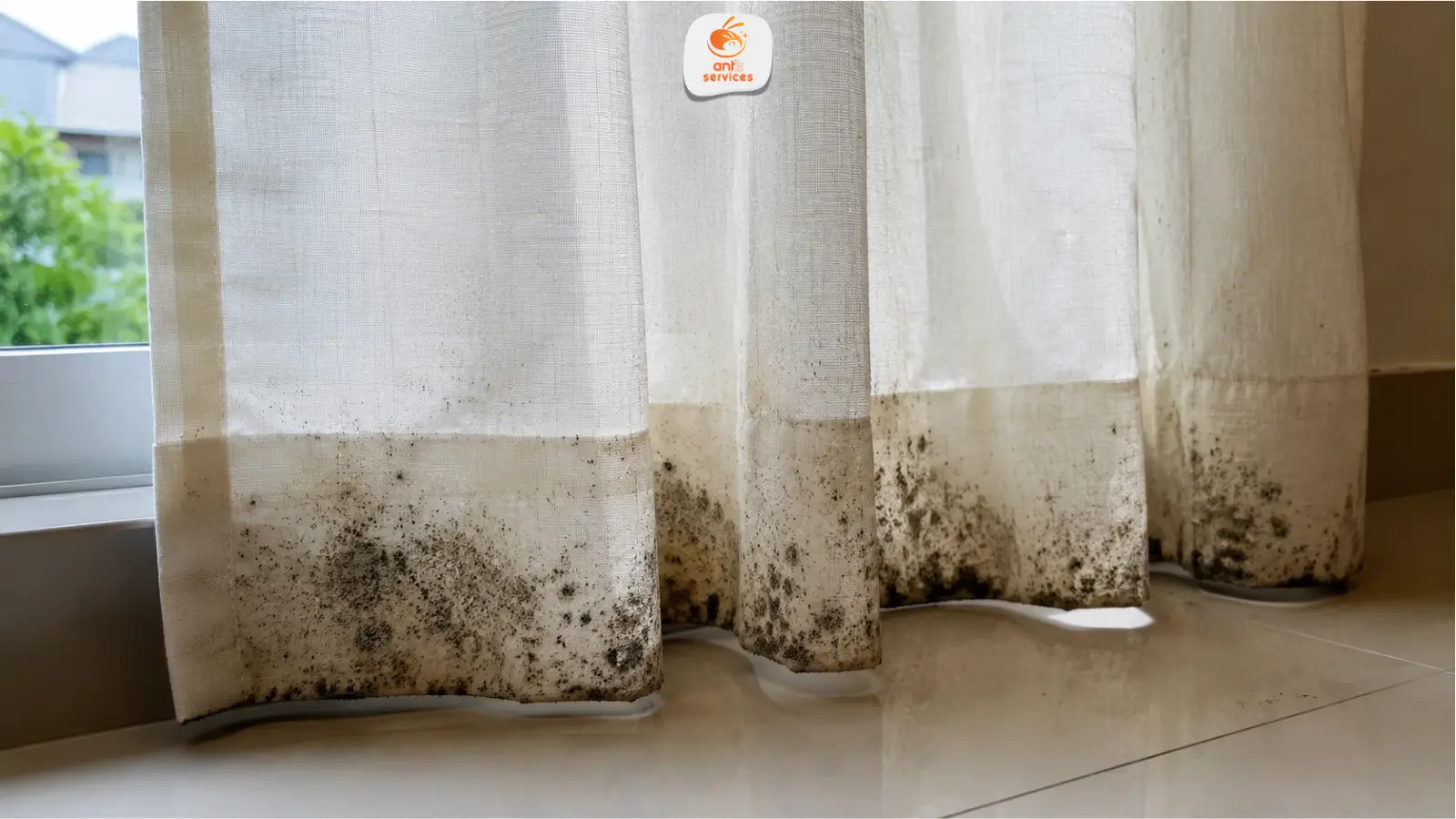
Finding dark spots on the hem or back of your curtains is one of the most common household problems in Malaysian homes. It is also one of the most misunderstood. Most curtain mould guides online are written for UK or Australian homes, where mould grows from cold window condensation in winter. Here the cause is different, the timing is different, and the solutions that work in temperate climates often damage Malaysian curtains rather than fix them. So this guide covers curtain mould Malaysia specifically: why it happens here, how to treat it safely without wrecking the fabric, and when professional steam cleaning is the right call.
Key Takeaways
- Curtain mould Malaysia is driven by year-round ambient humidity of 70 to 90 percent, not by cold window condensation as in UK or Australian guides.
- The most common location is the curtain hem, particularly on sliding door curtains where the hem sits close to the floor in a low-ventilation zone.
- The Southwest Monsoon, from May to September, pushes indoor humidity above 85 percent. This is when curtain mould develops fastest.
- Machine washing often damages Malaysian curtains, because blackout liners shrink, hooks distort, and rehanging in a high-rise is impractical.
- Professional on-site steam cleaning kills mould spores and removes visible mould without taking the curtains down.
Why Curtain Mould Malaysia Is Different From Other Countries
Before the solutions, it helps to understand why the problem here differs from the one described in most online guides.
UK and Australian guides describe mould that forms when warm indoor air hits cold window glass, creates condensation, and passes that moisture to the curtain touching the window. That is a seasonal problem. It peaks in winter and largely disappears in summer once the windows warm up.
Malaysia has no winter and no cold windows. Our windows stay warm all year, so the temperate cold-glass mechanism does not apply. Instead, three local factors drive it.
Ambient humidity of 70 to 90 percent. Malaysia’s humidity supplies moisture to curtain fabric continuously, with no condensation event needed. The fabric absorbs moisture from the surrounding air around the clock. Combine that with the dust and organic matter that settles on curtains, and you have ideal conditions for mould.
Southwest Monsoon humidity spikes. From May to September, indoor relative humidity often exceeds 85 percent in homes without continuous air conditioning. At that level, spore germination and growth speed up considerably. This is why curtain mould is most often noticed between June and October.
Low-ventilation zones at the hem. The hem is the most common starting point, especially where full-length curtains sit close to the floor near a sliding door. This zone gets minimal airflow and traps moisture rising from the floor surface. In air-conditioned rooms, cool indoor air meeting warm outdoor air at the sliding door can add localised moisture there too. Note that this is an air-conditioning effect, not the cold-glass condensation described in temperate guides. Together, these make the hem the most vulnerable point on any curtain in a Malaysian home.
Signs of Curtain Mould
Spotting it early is easier when you know what to look for.
Black or dark green spots. The clearest sign is dark spotting on the fabric surface, usually black, dark green, or sometimes grey. Spots at the hem are the most common starting point. On lighter fabrics, they may look grey or brown before they darken.
A musty or earthy smell. Mould produces a distinctive musty odour. If your curtains smell damp and earthy when disturbed, particularly as you open or draw them, mould is likely present inside the fabric even before spots appear.
Discolouration on the back panel. The side facing the window or sliding door is usually where mould develops first. So check the back regularly, especially at the hem and anywhere the fabric touches or nearly touches the window frame.
Stiffening at the hem. When mould establishes inside the fibres, the affected area can feel stiffer than the rest of the curtain. That suggests growth within the material rather than just on the surface.
What Makes It Worse in Your Home
Several factors decide which homes develop mould faster than others in the same climate.
Curtains that are never vacuumed. Dust settles on curtain fabric continuously, and that dust is what mould feeds on. Curtains that go unvacuumed build a much thicker food layer than those cleaned every few months.
Air conditioning off during the day. Homes that run the AC only at night, which is common in condominiums, see higher daytime humidity. That accelerates mould development in the fabric.
Curtains touching the floor. Curtains that sweep the floor pick up moisture from the surface, which matters most where mopping leaves the floor slightly damp. That moisture then concentrates at the hem.
No regular professional cleaning. Curtains that are never professionally cleaned accumulate months or years of embedded dust, moisture, and organic matter. Eventually that sustains a colony that becomes visible even in moderate humidity.
Kitchen-adjacent curtains. Curtains near open kitchens absorb cooking moisture, oil vapour, and food particles. All of these give mould extra food beyond ordinary dust.
How to Treat Curtain Mould Malaysia: DIY Methods
For small, recent mould spots, meaning less than a month old and covering a small area, home treatment can work. For established or widespread mould, professional treatment is more appropriate.
White vinegar spot treatment
White vinegar’s mild acidity kills mould spores on contact, and it is safe on most curtain fabrics. Dilute it 50/50 with water in a spray bottle. Spray the affected area and leave it for 15 minutes. Then blot with a clean white cloth. Never scrub, because scrubbing spreads spores across the fabric. Let it air dry fully before drawing the curtains.
Test an inconspicuous area first. Vinegar is generally fine on cotton, polyester, and linen, but it can affect certain dyes on more delicate fabrics.
Baking soda paste for stubborn spots
For slightly more established spots, mix baking soda with a little water into a paste. Apply it to the spot with a soft brush, leave it 20 minutes, then work it gently into the fabric and blot away. The mild abrasiveness lifts mould from the fibres without damaging them.
What not to do with Malaysian curtains
Do not use bleach on coloured or lined curtains. UK guides recommend it often, but it strips colour irreversibly and weakens the blackout lining that is standard on most Malaysian curtains.
Do not machine wash blackout curtains. Most full-length blackout curtains sold here have a rubberised or laminated lining that warps, peels, or shrinks in a machine wash, especially on a hot cycle. Many care labels specifically recommend dry cleaning or professional on-site steam cleaning only.
Do not take curtains down before checking how hard they are to rehang. In high-rise condominiums, particularly with ceiling-to-floor windows, removing and rehanging means a ladder and precise realignment of every hook or eyelet at height. That is a lot of work for a DIY treatment that may not fully clear the mould anyway.
When to Book Professional Steam Cleaning
On-site steam cleaning is the right treatment in four situations.
The mould covers more than a small area. Once spots spread across the hem or back panel, beyond roughly palm-sized, DIY spot treatment rarely clears it completely. By that stage the colony has usually established inside the fabric layers, beyond surface reach.
The mould returned after home treatment. If vinegar or baking soda worked and the mould came back within weeks, the root system is inside the fibres rather than on the surface. Steam penetrates the full fabric depth and kills mould at the root, which surface sprays cannot do.
The curtains are blackout or lined. These are not suitable for machine washing. They respond best to on-site steam treatment, which cleans them without removing them from the rail.
The curtains are in a high-rise unit. Taking down and rehanging curtains in a condo above the fifth floor involves real effort and access risk. On-site cleaning avoids that entirely, since the team works where the curtains hang.
Professional steam cleaning kills spores through heat, removes the visible mould and its food source, and deodourises the musty smell. All of it happens without taking the curtains off the rail. At Antz Services, curtain cleaning starts from RM70 per window across KL and Selangor, with no transportation charges. See our curtain cleaning KL guide for full pricing and process details.
How to Prevent Curtain Mould Malaysia From Returning
Once the mould is treated, whether by DIY or professionally, these habits stop it re-establishing.
Vacuum curtains every 2 to 3 months. This removes the dust layer that feeds mould. Use the upholstery attachment on low suction and run it down the full length, including the hem.
Keep the hem off the floor. If your curtains currently drag, rehang them so there is a small gap between hem and floor. That removes the main moisture source for hem mould.
Improve airflow around the curtains. Make sure they are not pressed flat against the glass or sliding door frame. A small gap allows circulation and reduces moisture buildup. Where possible, position the brackets slightly further from the glass.
Run air conditioning through the humid months. During the peak Southwest Monsoon period, keeping indoor humidity below 70 percent slows mould development considerably. Even short AC sessions twice a day in affected rooms make a measurable difference.
Book professional cleaning every 6 to 12 months. Regular steam cleaning clears accumulated organic matter and any early-stage mould before it becomes visible. Every 6 months suits curtains in humid rooms or near sliding doors. See our how often to clean curtains guide for guidance by room type and position.
When Curtains Need Replacing Instead
Sometimes the damage is too far gone for cleaning to restore an acceptable condition. Replacement is usually the better call when:
- Mould has penetrated the full thickness and shows on both faces
- The fabric has deteriorated, feeling stiff or brittle, or tearing at the affected area
- The blackout lining has separated or delaminated where the mould sat
- The smell persists after professional cleaning, which suggests deep root penetration
For curtains in that state, replacing them is the sensible decision. Once new ones are up, the prevention habits above will extend their mould-free life considerably.
Frequently Asked Questions
Why do my curtains keep getting mouldy in Malaysia?
Curtain mould Malaysia recurs because humidity of 70 to 90 percent feeds moisture into curtain fabric around the clock. The hem is most vulnerable, especially near sliding doors, because it sits in a low-ventilation zone where moisture concentrates. Mould returns after home treatment because surface sprays do not reach the root system inside the fibres.
Can mouldy curtains be cleaned, or do they need replacing?
For small, recent spots, DIY vinegar treatment or professional steam cleaning removes the mould effectively. For widespread mould, or mould that has gone through the full fabric thickness, professional steam cleaning gives the best result. Curtains where the fabric has structurally deteriorated, or the blackout lining has separated, are better replaced.
Is curtain mould dangerous?
Mould on curtains releases spores into indoor air continuously, particularly when the curtains are moved. For anyone with asthma, allergic rhinitis, or respiratory sensitivity, that can worsen symptoms. Children and elderly family members tend to be most affected. So treating curtain mould promptly is a health measure as much as a cosmetic one. If someone at home has ongoing respiratory symptoms, speak to a doctor as well as dealing with the mould.
How do I prevent curtain mould during monsoon season?
Through the peak months of May to September, run the AC more often to hold indoor humidity below 70 percent. Keep the hem clear of the floor, open windows on dry days for circulation, and vacuum the full curtain length monthly rather than quarterly.
How much does professional curtain mould removal cost in Malaysia?
Antz Services charges from RM70 per window for on-site curtain steam cleaning, which kills spores and removes visible mould. Sheer and voile panels are RM10 per piece. Ceiling-height curtains are RM1.50 per sqft. No transportation charges apply across more than 62 areas in KL and Selangor. See our curtain cleaning Selangor guide for Selangor coverage.
Conclusion
Curtain mould Malaysia develops differently from curtain mould in the UK or Australia. Year-round ambient humidity, not cold window condensation, is the cause here. The hem near sliding doors is the most vulnerable point, and the Southwest Monsoon accelerates growth every year. For small, recent spots, carefully applied diluted white vinegar is an effective first treatment. For established or recurring mould, professional on-site steam cleaning kills it at the root without taking the curtains off the rail.
Need Help With Curtain Cleaning?
Antz Services helps households across KL & Selangor with professional curtain cleaning to remove dust, odours, and buildup while keeping your space fresh and presentable.


